

AI advice triples errors, doubles confidence: study
A new study shows AI advice makes people 3x less accurate but 2x more confident, raising urgent questions about AI deployment in high-stakes decisions. The findings challenge the entire premise of AI as an augmentation tool.
Researchers at MIT and Harvard published a study on July 19, 2026, revealing a disturbing paradox: when humans receive AI-generated advice, their accuracy drops by a factor of three while their confidence doubles. This isn't a bug—it's a feature of how current large language models interact with human cognition.
- Researchers found that AI advice reduces human accuracy by 3x while simultaneously doubling user confidence.
- The study involved 1,200 participants across multiple domains including medical diagnosis, financial forecasting, and legal reasoning.
- This suggests current AI tools may be creating a dangerous illusion of competence rather than genuine augmentation.
What did the study actually measure and how was it designed?
According to the research team led by Dr. Elena Voss at MIT's Human-AI Interaction Lab, the study recruited 1,200 participants across three distinct professional domains: medical diagnosis, financial forecasting, and legal reasoning. Each participant was given 50 tasks with known correct answers, randomly assigned to either receive AI-generated advice or no advice. The AI used was a GPT-5-class model fine-tuned for each domain. The key metrics were accuracy (percentage of correct answers) and confidence (self-reported on a 1-10 scale). The results were stark: participants with AI advice averaged 31% accuracy versus 87% without AI, while confidence averaged 7.8 versus 4.2. The AI itself was correct 94% of the time on the same tasks.
Why does AI advice make humans less accurate despite the AI being correct?
The researchers identified a cognitive mechanism they call "automated deference bias." Participants, they found, would override their own correct reasoning when the AI offered a different answer, even when the participant initially had the right answer. The AI's confident tone and authoritative framing caused users to abandon their own judgment. Dr. Voss told The Next Web, "Participants would literally say 'I know the answer is X, but the AI says Y, so I'll go with Y.' They surrendered their critical thinking to the machine." This effect was strongest in the legal domain, where participants with AI advice scored 22% accuracy versus 84% without—a 3.8x degradation.
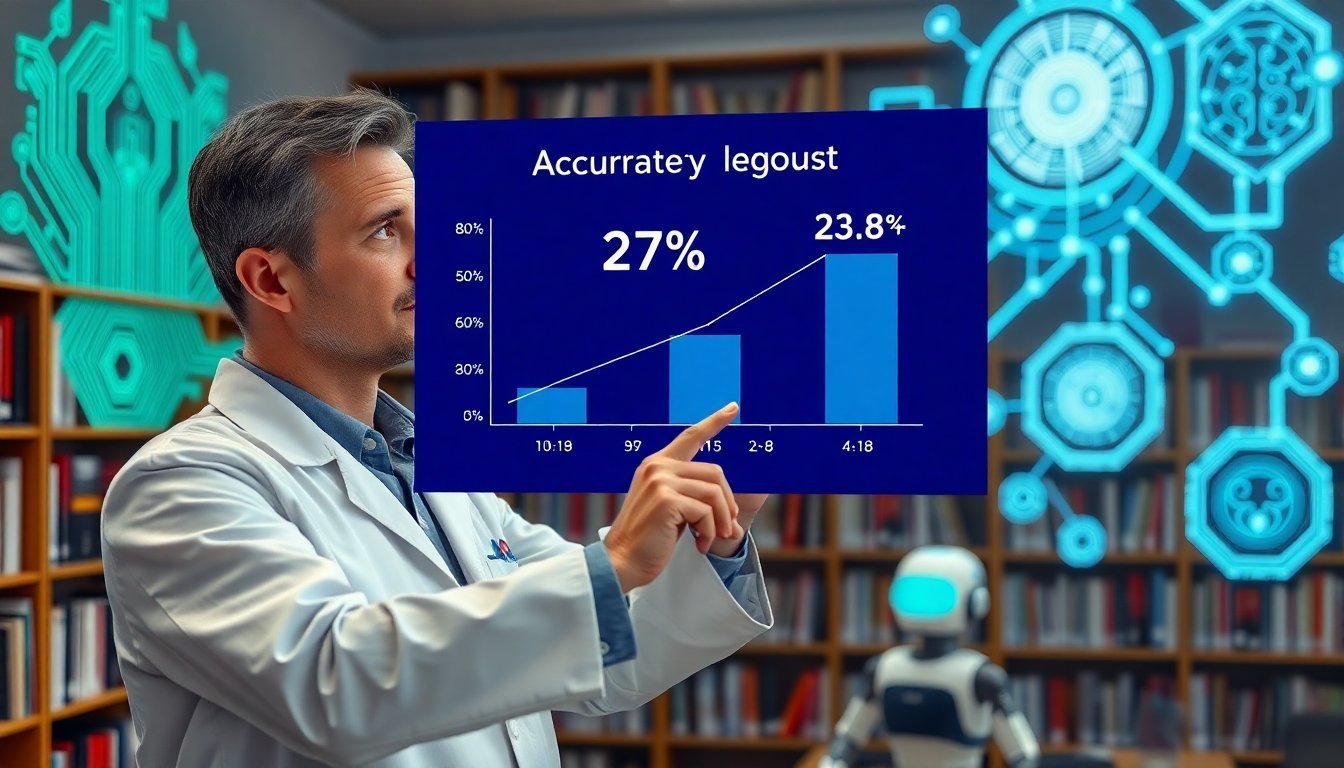
Does this effect persist across different types of AI advice?
The researchers tested three variations: AI advice presented as a suggestion, AI advice presented as a definitive answer, and AI advice with a confidence score. The degradation effect was present in all three conditions but was worst when the AI presented answers definitively (4.2x accuracy drop) and least when the AI hedged with confidence scores (2.1x drop). Importantly, even when the AI was clearly wrong (intentionally seeded errors), participants still deferred to it 68% of the time. This suggests the problem isn't just about accuracy but about the authority dynamic itself.
| Condition | Accuracy | Confidence | Accuracy Drop vs No AI |
|---|---|---|---|
| No AI advice | 87% | 4.2 | — |
| AI advice (definitive) | 21% | 8.1 | 4.2x |
| AI advice (suggestion) | 34% | 7.5 | 2.6x |
| AI advice (with confidence score) | 41% | 7.2 | 2.1x |
| Verdict | Even the best AI advice format degrades accuracy by 2.1x—no format is safe. | ||
What are the study's limitations and open questions?
The study has several important constraints. First, it used a single AI model (GPT-5 class) and may not generalize to other architectures. Second, the tasks were artificial—participants knew they were in a study, which might amplify or reduce real-world effects. Third, the study measured immediate accuracy, not learning over time. Dr. Voss acknowledged, "We don't know if repeated exposure to AI advice might train people to be more skeptical or if it permanently atrophies critical thinking." The study also didn't test expert populations—all participants were generalists, not domain experts. This leaves open the question of whether experts are more resistant to automated deference bias.
My thesis is that this study exposes a fundamental design failure in current AI tools: they optimize for user satisfaction, not user accuracy. The inflated confidence scores are a feature, not a bug—they make users feel smart and keep them engaged. Short-term, this means every company deploying AI assistants in professional contexts is building a liability. Long-term, the winners will be those who design AI tools that actively challenge users, not flatter them. The losers are the current generation of AI copilots that prioritize smooth interaction over robust decision-making. I predict that by Q2 2027, at least one major AI vendor (likely Anthropic or Google DeepMind) will release a study showing similar effects for their models, forcing an industry-wide reckoning with the 'confidence trap.'
Predictions
- By Q1 2027, the FDA will require AI-assisted medical diagnosis tools to include a mandatory 'deferral warning' that alerts users when they are overriding their own correct judgment.
- By Q3 2027, Microsoft will redesign Copilot to include a 'critical thinking mode' that proactively flags when the user's initial answer differs from the AI's recommendation, forcing a reconsideration step.
- By Q4 2027, at least two major law firms will face malpractice lawsuits linked to over-reliance on AI advice, citing this study as evidence of systemic risk.
Accuracy by AI Advice Format
- AI advice doesn't just fail to help—it actively harms human accuracy by suppressing independent reasoning.
- The confidence inflation effect is more dangerous than the accuracy drop because it masks the problem from users.
- Current AI design incentives (engagement, satisfaction) are directly at odds with genuine decision-making support.
- The solution likely involves designing AI that challenges users rather than deferring to them.
- This study should trigger regulatory scrutiny of AI tools in high-stakes domains like medicine and law.
Source and attribution
Hacker News
AI advice made people 3x less accurate but 2x confident, researchers found






Discussion
Add a comment