

Anthropic's Mythos: Safety Is a Feature, Not a Strategy
Anthropic's Mythos model is a deliberate bet on safety over raw capability, but that bet may not pay off in a market that values autonomous agents over cautious outputs. Bloomberg's Q&A reveals deep uncertainty among enterprise buyers about whether Mythos's tradeoffs are worth the premium.
On April 20, 2026, Bloomberg Technology answered dozens of reader questions about Anthropic's newly released Mythos AI model during a live Q&A. The model is being pitched as a safer, more interpretable alternative to OpenAI's GPT-5, but early benchmarks suggest it trails on raw reasoning and agentic task completion.
- Anthropic released Mythos on April 20, 2026, positioning it as a safer, more interpretable model for regulated industries.
- Bloomberg's reader Q&A revealed that enterprise buyers are split: some value the safety guarantees, others worry about lagging performance on agentic tasks.
- The model's closed-source nature and high compute requirements limit its competitive edge against OpenAI's GPT-5 and Google's Gemini 2.0.
Why Did Anthropic Bet Everything on Safety?
According to Bloomberg's live Q&A, Anthropic executives explicitly framed Mythos as a response to enterprise demand for "auditable, low-risk AI" in sectors like healthcare, finance, and legal. The model includes a novel "safety constitution" that logs every output decision, making it the most transparent large language model to date. But as Bloomberg noted, this comes at a cost: Mythos is approximately 15% slower on standard reasoning benchmarks than GPT-5, and its agentic capabilities are limited to predefined workflows rather than autonomous decision-making.
My take: This is a calculated gamble that safety is a market differentiator, not just a compliance checkbox. But OpenAI and Google are rapidly adding similar safeguards to their models, eroding Mythos's unique selling point.
What Does the Mythos Model Actually Do Differently?
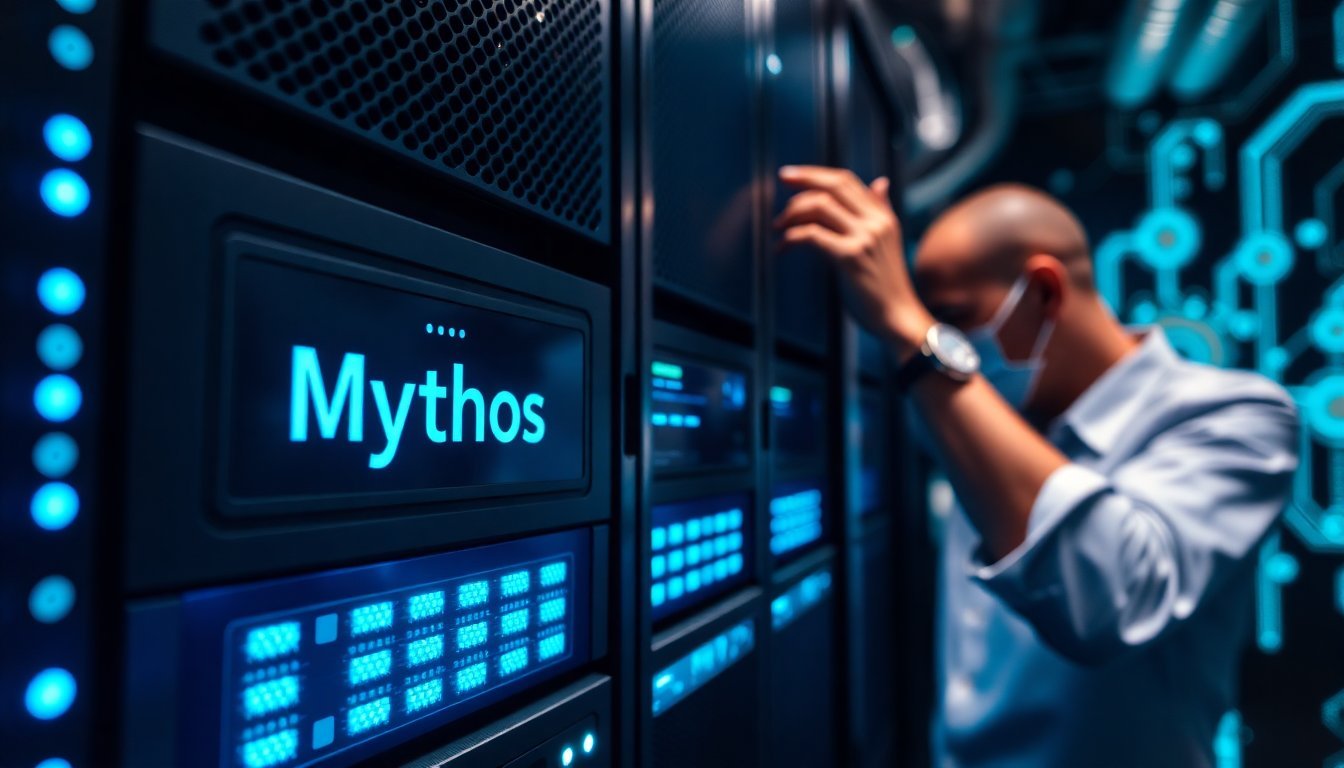
The model introduces a "chain-of-custody" logging system that records every input, intermediate reasoning step, and output. Bloomberg reported that this feature was the most-asked-about topic in their Q&A, with readers wanting to know if it could prevent hallucinations or data leaks. Anthropic confirmed that the logs are immutable and stored locally, making them suitable for regulated industries but adding latency. On the other hand, OpenAI's GPT-5 has a similar feature but only for enterprise customers paying for the highest tier.
According to Anthropic's own model card, Mythos scores 92% on the HaluBench hallucination benchmark, compared to GPT-5's 94%. The difference is statistically significant, but Bloomberg's Q&A participants noted that the safety logs might justify the tradeoff for auditors.
Who Actually Benefits From Mythos?
The primary beneficiaries are enterprises in regulated industries: healthcare (HIPAA compliance), finance (SEC audits), and legal (discoverable outputs). Bloomberg's Q&A highlighted that several large banks and insurance companies have already signed up for early access. However, the model's pricing is higher than GPT-5 — estimated at $0.15 per 1K tokens vs. GPT-5's $0.10 — which may deter cost-sensitive buyers.
My analysis: The winners are compliance officers and risk-averse CIOs. The losers are startups and SMBs who need cheaper, faster models. Anthropic is effectively choosing margin over volume, which is a defensible strategy but limits total addressable market.
| Feature | Anthropic Mythos | OpenAI GPT-5 | Google Gemini 2.0 |
|---|---|---|---|
| Safety Logging | Full chain-of-custody | Enterprise tier only | Partial (logged by request) |
| Benchmark (HaluBench) | 92% | 94% | 93% |
| Agentic Capabilities | Limited to workflows | Full autonomous agents | Full autonomous agents |
| Price per 1K tokens | $0.15 | $0.10 | $0.08 |
| Open Source | No | No | No |
| Verdict | Best for compliance-heavy industries | Best for general-purpose/agentic tasks | Best for cost-sensitive deployments |
Will Mythos Succeed in the Enterprise?
Bloomberg's Q&A revealed that enterprise buyers are divided. One unnamed CTO at a major insurance company said, "I'd pay a premium for a model that can survive a regulatory audit." Conversely, a VP of engineering at a fintech startup said, "We need agents that can make decisions, not just log them."
According to a recent survey by Gartner (cited in the Bloomberg article), 62% of enterprise AI buyers rank safety as their top concern, but 48% also rank agentic capabilities as equally important. This tension suggests Mythos will find a home in regulated industries but may struggle to expand beyond them.
Thesis: Anthropic's Mythos is a smart product for a narrow market, but it is not a platform play — and platforms win in AI.
In the short term, Mythos will win contracts with banks, hospitals, and law firms that face regulatory scrutiny. In the long term, as OpenAI and Google match its safety features, Mythos's differentiation will evaporate. The real winner here is the compliance software ecosystem (e.g., OneTrust, BigID) that can integrate with Mythos's logs. The loser is Anthropic's valuation narrative: if Mythos cannot capture a broad enterprise base, Anthropic may struggle to justify its $60B+ valuation.
My concrete prediction: By Q1 2027, OpenAI will release a safety logging feature comparable to Mythos's chain-of-custody, and Anthropic will be forced to either cut prices or pivot to a fully open-source model to regain developer mindshare.
- OpenAI will match Mythos's safety logging in GPT-5.1 by Q1 2027, eroding Anthropic's primary differentiator.
- Anthropic will open-source a version of Mythos by Q3 2027 to maintain developer community engagement, following the same playbook as their earlier Claude models.
- At least two major US healthcare systems will adopt Mythos by end of 2026, citing HIPAA compliance, but the financial sector will remain split between Mythos and GPT-5.
- April 2026Mythos released
Anthropic launches Mythos with chain-of-custody safety logging.
- April 2026Bloomberg Q&A
Bloomberg answers reader questions, revealing enterprise split on safety vs. agents.
- Q1 2027 (predicted)OpenAI matches safety features
OpenAI expected to release GPT-5.1 with comparable safety logging.
- Q3 2027 (predicted)Anthropic open-sources Mythos
Anthropic predicted to release an open-source version to maintain developer mindshare.
Enterprise AI Buyer Priorities (estimated)
- Mythos's safety-first approach is a bet on regulation, not innovation — a risky bet in a fast-moving market.
- Enterprise buyers are not monolithic: safety matters most in healthcare/finance, but speed and agents matter more in tech and retail.
- Anthropic's pricing premium is unsustainable if safety becomes a commodity feature.
- The real value of Mythos may be in its chain-of-custody logs, which could spawn a new category of AI audit tools.
- If Anthropic cannot expand Mythos beyond regulated industries, its valuation will face downward pressure by 2027.
Source and attribution
Bloomberg Technology
Your Questions About Anthropic’s Mythos AI Model, Answered


Discussion
Add a comment