
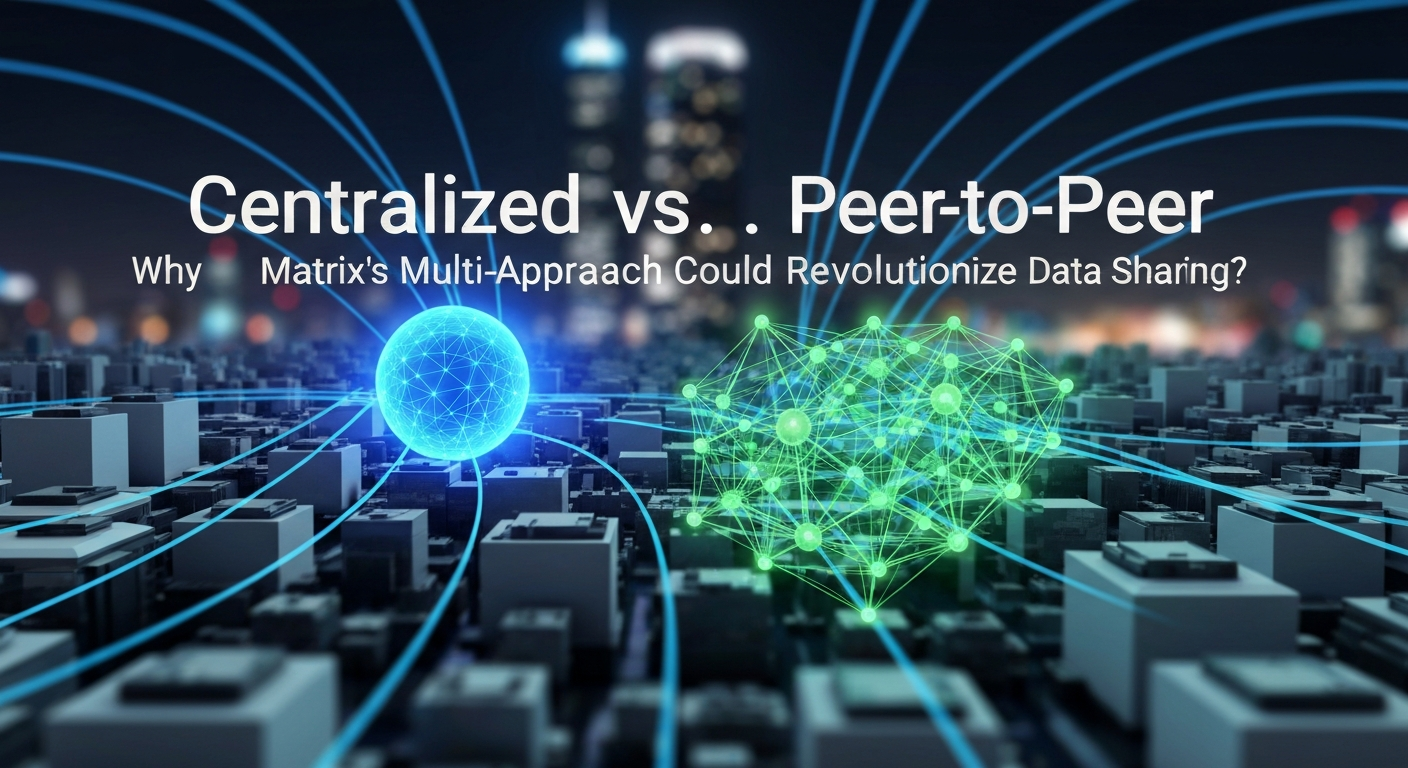
Centralized vs. Peer-to-Peer: Why Matrix's Multi-Agent Approach Could Revolutionize Synthetic Data
A new framework called Matrix is challenging the centralized status quo of AI data generation. By enabling agents to coordinate peer-to-peer, it promises to eliminate bottlenecks and unlock unprecedented scale for creating the training data that fuels modern LLMs.
What if the biggest bottleneck in AI isn't a lack of algorithms, but a flawed production line? The synthetic data used to train modern AI is largely created through a painfully centralized process, a single point of control that stifles the scale and diversity these systems desperately need.
Enter Matrix, a new framework that flips the script. By enabling AI agents to coordinate peer-to-peer like a swarm, it promises to shatter this bottleneck and unlock a revolution in how we build the foundational data for everything from chatbots to self-driving cars.
Enter Matrix, a new framework that flips the script. By enabling AI agents to coordinate peer-to-peer like a swarm, it promises to shatter this bottleneck and unlock a revolution in how we build the foundational data for everything from chatbots to self-driving cars.
The Bottleneck in Building Better AI
Imagine trying to produce a Hollywood blockbuster with a single director micromanaging every actor, set designer, and special effects technician. The process would be agonizingly slow, prone to failure, and impossible to scale. According to researchers behind a new paper on arXiv, this is precisely the flawed architecture underpinning most synthetic data generation for artificial intelligence today. As the demand for high-quality, privacy-preserving training data explodes, the centralized orchestrator model has become the critical bottleneck holding back progress.
Enter Matrix, a novel framework proposing a radical shift: a peer-to-peer (P2P) network of specialized AI agents that collaborate without a central command. This isn't just an incremental improvement; it's a fundamental rethinking of how we generate the synthetic datasets that train everything from chatbots to autonomous systems. In a world where real data is often scarce, expensive, or legally fraught, the ability to efficiently generate vast, diverse, and complex synthetic data isn't a luxury—it's the cornerstone of the next AI leap.
Why Centralized Control Is Failing AI Data Factories
Today's multi-agent synthetic data systems typically rely on a central "orchestrator" or "controller" agent. This master agent is responsible for task decomposition, assigning roles to specialized worker agents (like a "writer," "critic," or "validator"), and sequencing their work. Think of it as a single-project manager trying to coordinate a team of 100 experts.
The problems with this approach are becoming glaringly obvious as tasks grow in complexity:
- Scalability Ceiling: The central orchestrator becomes a single point of failure and a performance bottleneck. As you add more agents to improve quality or diversity, the orchestrator's workload increases, slowing the entire system.
- Rigid Workflows: These systems are often hardcoded for specific tasks—like generating Q&A pairs or code snippets. Adapting them to a new type of data (e.g., multi-turn dialogues, complex reasoning chains, or structured data for scientific training) requires significant re-engineering.
- Lack of Resilience: If the orchestrator fails, the entire production line halts. There's no inherent redundancy or ability for agents to self-organize around a problem.
"The current paradigm is like building a factory where every machine needs instructions from one central computer," the Matrix paper suggests. "What we need is a swarm intelligence, where machines can talk to each other and get the job done collaboratively."
Matrix: The Swarm Intelligence for Data Generation
Matrix proposes flipping the script. Instead of a top-down hierarchy, it envisions a decentralized network where autonomous agents discover each other, negotiate tasks, and collaborate directly. The framework provides the "rules of the road"—communication protocols, contract interfaces, and verification mechanisms—that allow this swarm to function productively.
Here’s a simplified view of how it works:
- Agent Specialization: Different agents register their capabilities with the network (e.g., "I can generate Python code," "I can critique logical consistency," "I can ensure ethical guidelines").
- Task Propagation: A data generation task is introduced to the network. Rather than being assigned by a boss, the task is broadcast or discovered by agents.
- Peer-to-Peer Coordination: Agents form ad-hoc, temporary teams to tackle the task. A "writer" agent might generate a draft, then directly contract a "critic" agent for feedback, and a "refiner" agent to polish the output—all through bilateral agreements.
- Emergent Workflow: The workflow isn't pre-defined by a programmer. It emerges from the interactions of the agents based on the task's needs and the available specialists in the network.
This architecture mirrors successful decentralized systems in other domains, like blockchain networks or packet-switching on the internet. The intelligence and control are distributed, making the system inherently more scalable and robust.
The Tangible Advantages: Scale, Cost, and Creativity
The shift from centralized to peer-to-peer isn't academic; it translates into direct, practical benefits for anyone building or using AI.
1. Linear Scalability: In a Matrix-like system, adding more agents increases throughput linearly, not logarithmically. Need more data? Spin up more agents. The network absorbs them without requiring a re-architected central brain. This is crucial for generating the billion-scale datasets required to train frontier models.
2. Cost Efficiency: Centralized orchestrators are often the most complex and expensive agents to run, requiring powerful (and costly) LLMs. By distributing the coordination logic, Matrix can potentially utilize a heterogeneous mix of smaller, cheaper, and more efficient models for the actual work, dramatically reducing compute costs per data point.
3. Richer, More Creative Data: Hardcoded workflows tend to produce formulaic data. A decentralized swarm can explore more creative generation paths. Different agent teams might tackle the same problem in parallel, producing a more diverse set of outputs. This diversity is the antidote to the synthetic data "inbreeding" and loss of novelty that researchers warn about.
4. Built-in Adaptability: Because agents negotiate workflows on the fly, the same network can be tasked with generating dramatically different types of data—from legal documents to protein sequences—without manual reconfiguration. The system's flexibility becomes its superpower.
The Challenges on the Horizon
Of course, the peer-to-peer vision is not without its hurdles. Ensuring consistent quality without central oversight is a major challenge. Matrix would need robust reputation systems for agents and cryptographic verification for outputs to prevent low-quality or malicious agents from polluting the data pool. Furthermore, debugging a complex, emergent interaction between dozens of agents is far more difficult than tracing a linear, programmed workflow.
The research is still in its early stages, presented as a framework and vision rather than a fully-baked product with extensive benchmarks. The real test will be in its implementation: Can it deliver the promised scalability without sacrificing the reliability and controllability that centralized systems offer?
The Future of AI's Data Supply Chain
The implications of a successful shift to decentralized synthetic data generation are profound. It could democratize access to high-quality training data, allowing smaller research labs and companies to generate custom datasets at scale. It could accelerate the development of specialized AI for medicine, law, and science by making it easier to generate domain-specific training corpora that respect privacy.
More broadly, Matrix points to a future where AI development itself becomes more decentralized. If the data generation layer can operate as a resilient, scalable swarm, why not other layers of the AI stack? This framework is a step toward a more robust, efficient, and collaborative AI ecosystem—one less dependent on monolithic, centralized control.
The race for better AI is, in large part, a race for better data. For years, the focus has been on the models themselves—making them bigger, faster, smarter. Frameworks like Matrix suggest the next breakthrough might not be in the brain of the AI, but in the factory that builds its fuel. The choice between a single director and a collaborative swarm may well determine the pace of innovation for the next decade.
Source and attribution
arXiv
Matrix: Peer-to-Peer Multi-Agent Synthetic Data Generation Framework




Discussion
Add a comment