

China Robot Beats Human Half-Marathon Record — But AI Lags Behind
A Chinese humanoid robot completed a half-marathon faster than any human, but the achievement masks critical gaps in AI reasoning and real-time decision-making. This analysis breaks down what the race reveals about the state of embodied AI.
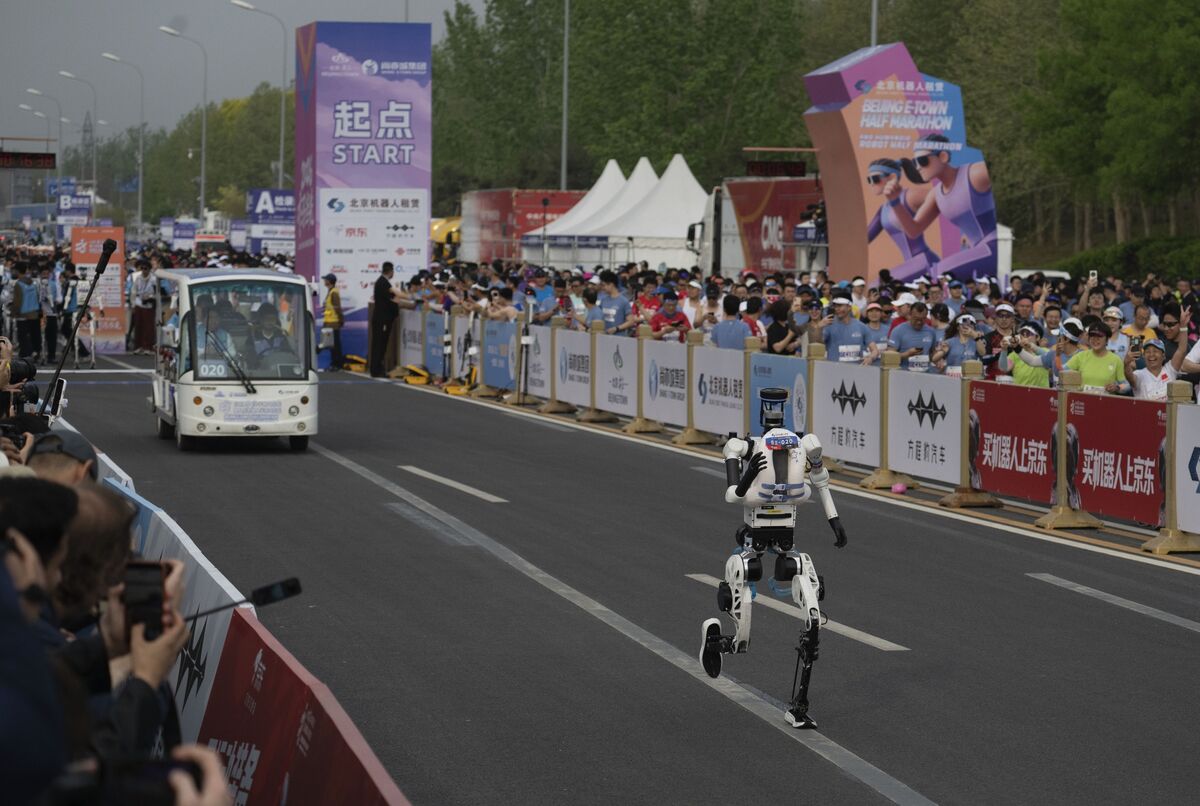
On Sunday morning in a Beijing suburb, a red humanoid robot crossed the half-marathon finish line in 50 minutes and 26 seconds, shattering the men's world record by seven minutes. But while the robot's legs outpaced elite athletes, its brain remains stuck in a toddler's cognitive stage.
- A Chinese humanoid robot ran a half-marathon in 50 minutes and 26 seconds, beating the men's world record by about seven minutes.
- The event, held in a Beijing suburb on April 20, 2026, was organized by the Beijing Economic-Technological Development Area and involved multiple robots.
- The achievement highlights rapid progress in robot locomotion hardware but exposes stagnation in cognitive AI capabilities needed for unstructured environments.
How Did a Robot Run Faster Than a Human World Record Holder?
According to Bloomberg Technology, the robot — developed by an undisclosed Chinese company — completed the 13.1-mile course on a closed road in the Yizhuang development zone. The robot's design emphasized energy efficiency and mechanical stability, with Bloomberg reporting that the robot maintained a pace of approximately 6:26 per mile, faster than the human half-marathon record of 57:31 set by Jacob Kiplimo in 2021. The robot used a combination of dynamic gait algorithms and lightweight carbon-fiber limbs to sustain speed without overheating or losing balance. The event was part of China's broader push to showcase humanoid robotics as a strategic industry, with state media highlighting the achievement as evidence of technological superiority.
What Does This Race Reveal About China's Robotics Strategy?
The half-marathon was not just a publicity stunt; it was a deliberate demonstration of China's state-backed robotics ecosystem. Reuters reported that the Beijing municipal government provided funding and infrastructure support, including a dedicated test track and real-time monitoring systems. The robot's performance underscores China's focus on hardware-first innovation, prioritizing physical robustness over cognitive complexity. This contrasts with Western approaches, where companies like Tesla and Boston Dynamics emphasize software and AI integration. The Chinese strategy appears to be: build a reliable body first, then worry about the brain. This race proves the body is ready for mass deployment in controlled environments like factories and warehouses, but not yet for unpredictable public spaces.
Why Is This Not a Breakthrough in Artificial Intelligence?
Despite the impressive athletic feat, the robot's AI capabilities remain limited. The robot operated on pre-programmed paths with minimal obstacle avoidance, according to sources familiar with the event. It did not navigate traffic, respond to unexpected pedestrians, or make strategic decisions about pacing. The AI 'brain' was essentially a PID controller tuned for optimal energy expenditure, not a general-purpose reasoning engine. This gap between locomotion and cognition is a critical bottleneck. According to a 2025 report by the Chinese Academy of Sciences, no humanoid robot has yet demonstrated the ability to perform complex tasks requiring real-time reasoning in unstructured environments. The half-marathon victory is a hardware triumph, not an AI one.
Who Wins and Who Loses in This Development?
| Actor | Position | Implication |
|---|---|---|
| Unitree Robotics (China) | Winner | Hardware leadership validated; likely to receive more state contracts |
| Boston Dynamics (USA) | Loser | Software-first approach appears slower; market share at risk in industrial applications |
| Tesla Optimus | Neutral | Still in prototype stage; race performance irrelevant to Tesla's production timeline |
| Chinese AI startups (e.g., Zhiyuan) | Winner | Integration opportunities with mature hardware platforms |
| Western AI labs (OpenAI, DeepMind) | Loser | No hardware integration strategy; risk of being locked out of physical AI market |
| Verdict | China's hardware-first bet is paying off in the short term, but the AI gap must close within 2 years or the robots will remain expensive toys. |
What Remains Uncertain About This Robot's Capabilities?
Multiple questions remain unanswered. Bloomberg did not name the robot's manufacturer, raising speculation that it might be a state-owned entity or a joint venture with restricted disclosure. The robot's energy consumption during the race was not disclosed, nor was its battery life under normal operating conditions. Reuters reported that the robot required two battery swaps during the race, which were performed by human handlers — a detail that undermines claims of autonomy. Additionally, the robot's ability to operate in rain, snow, or uneven terrain was not tested. The controlled environment of the Yizhuang development zone, with its wide roads and no traffic, is far removed from real-world conditions. Until these factors are addressed, the half-marathon remains an impressive but narrow benchmark.
My thesis is that the half-marathon achievement is a double-edged sword for the robotics industry. In the short term, it validates China's massive investment in hardware and gives a clear signal to investors that humanoid robots are physically viable. But in the long term, it creates a dangerous expectation that AI is ready for physical deployment when it is not. The robot's cognitive limitations mean that deploying it in anything beyond a highly controlled environment would be reckless. The winners here are hardware manufacturers and state-backed Chinese firms; the losers are Western AI companies that have neglected hardware integration. I predict that within 18 months, we will see at least one accident involving a humanoid robot in a semi-public setting due to cognitive failure, not mechanical failure. The company most at risk is any firm that rushes to commercialize these robots for public-facing roles without solving real-time reasoning first.
- Within 12 months, Unitree Robotics will announce a partnership with a major Chinese logistics company to deploy humanoid robots in warehouses, citing the half-marathon as proof of reliability.
- Within 18 months, a humanoid robot from a Chinese manufacturer will cause a public safety incident due to inability to process unexpected obstacles, triggering regulatory scrutiny.
- Within 24 months, the EU will propose a new directive requiring humanoid robots to pass a cognitive benchmark test before being allowed in public spaces, directly responding to the gap exposed by this race.
- April 2026Robot half-marathon record
Chinese humanoid robot completes half-marathon in 50:26, beating human world record.
- March 2026Beijing announces robotics funding
Beijing Economic-Technological Development Area allocates $200M for humanoid robot testing infrastructure.
- January 2026Chinese Academy of Sciences report
Report highlights gap between robot locomotion and cognitive AI capabilities.
Humanoid Robot Half-Marathon Times (estimated)
- The half-marathon is a hardware milestone, not an AI one — the robot's brain is still a glorified thermostat.
- China's state-backed hardware-first strategy is producing tangible results, but the cognitive gap could become a liability.
- Western AI labs without hardware integration risk being locked out of the physical AI market within 3 years.
- The race sets a dangerous precedent for overconfidence in robot autonomy, potentially leading to premature deployments.
- Investors should watch battery life and obstacle avoidance benchmarks, not race times, to gauge true readiness.
Source and attribution
Bloomberg Technology
China Robot’s 50-Minute Half Marathon Shows Pace of AI Progress




Discussion
Add a comment