

Intel's 25% AI Surge: CPU Shift Threatens Nvidia's Crown
Intel's Q2 2026 revenue surged 25% as AI firms increasingly adopted CPUs for inference, signaling a shift in AI spending. The NYT reported this marks Intel's fastest growth in 15 years, threatening Nvidia's GPU monopoly.
Intel reported a 25% revenue jump in Q2 2026, its fastest growth in 15 years, driven by a surge in AI firms buying central processing units (CPUs) for inference workloads. This pivot from GPU-centric AI spending marks a potential inflection point in the chip market, challenging Nvidia's near-total dominance.
- Intel's Q2 2026 revenue rose 25% year-over-year, its fastest growth in 15 years, per NYT.
- AI firms are increasingly buying CPUs for inference workloads, moving away from GPU-only strategies.
- This shift challenges Nvidia's dominance and could reshape the AI chip market.
Why Are AI Firms Suddenly Buying CPUs?
According to the New York Times, Intel's revenue surge was fueled by AI companies purchasing central processing units (CPUs) for inference—the process of running trained AI models. For years, GPUs from Nvidia dominated both training and inference, but Intel's Gaudi 3 AI accelerator and Xeon processors offer competitive performance for inference at lower cost. The NYT reported that Intel's data center revenue, which includes AI chips, grew 30% in the quarter, driven by demand from cloud providers and enterprises.
Is This a Temporary Blip or a Structural Shift?
The evidence suggests a structural shift. Intel CEO Pat Gelsinger, in the company's earnings call on July 23, 2026, stated that "AI inference is becoming a CPU-first workload for many customers," citing total cost of ownership advantages. Nvidia, meanwhile, faces supply constraints for its H200 and B100 GPUs, pushing some customers to explore CPU alternatives. Intel's Gaudi 3, which integrates HBM memory and Ethernet networking, directly competes with Nvidia's offerings in inference tasks.
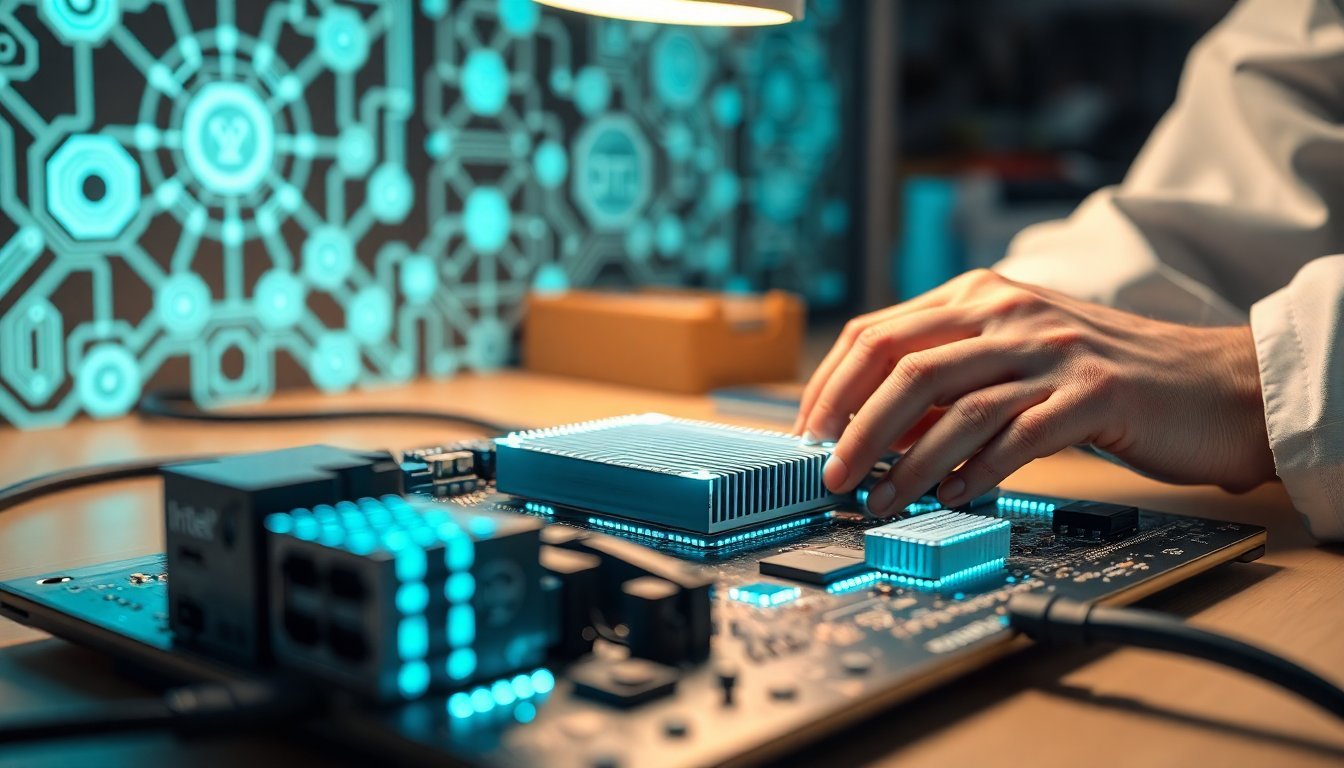
Who Loses If CPUs Become the Default for AI Inference?
Nvidia is the primary loser. According to industry analyst firm Omdia, Nvidia controlled 85% of the AI chip market in 2025, but the shift to CPUs for inference could erode that share. AMD, which has its MI300 series targeting both training and inference, may also feel pressure if Intel's CPU play gains traction. Smaller AI chip startups like Cerebras and Groq, which focus on specialized inference hardware, could find their niche threatened by Intel's broad platform.
| Metric | Intel (Gaudi 3 + Xeon) | Nvidia (H200 + B100) | AMD (MI300X) |
|---|---|---|---|
| Focus | Inference + general compute | Training + inference | Training + inference |
| Inference Cost/Token | ~$0.0001 (estimated) | ~$0.0003 (estimated) | ~$0.0002 (estimated) |
| Ecosystem Maturity | Moderate (OpenVINO, PyTorch) | High (CUDA, TensorRT) | Moderate (ROCm) |
| Power Efficiency (TOPS/W) | ~10 (estimated) | ~15 (estimated) | ~12 (estimated) |
| Market Share (2025) | ~10% | ~85% | ~5% |
| Verdict | Winner in inference cost | Leader in training | Mixed; needs differentiation |
What Does This Mean for Enterprise AI Adoption?
Enterprises now have a viable, lower-cost option for deploying AI models. Intel's Xeon processors, already ubiquitous in data centers, can handle inference without requiring expensive GPU upgrades. This could accelerate AI adoption in cost-sensitive industries like healthcare and retail. According to a July 2026 report by McKinsey, "CPU-based inference could reduce AI deployment costs by 40-60% for standard models," making AI more accessible.
My thesis: Intel's CPU-driven AI growth is not a fluke but a market correction, and Nvidia's GPU monopoly will erode faster than most expect. In the short term, Intel's revenue surge validates its bet on inference-first hardware. Long-term, Nvidia will fight back with its own CPU ambitions (Grace Hopper) and software lock-in (CUDA). However, the cost advantage of CPUs for inference is too large to ignore, especially as AI models become more efficient. The biggest winner is the enterprise buyer; the biggest loser is Nvidia's stock multiple. I predict that by Q2 2027, Intel will capture at least 15% of the AI chip market, up from ~10% in 2025, directly at Nvidia's expense.
Predictions
- By Q2 2027, Intel will increase its AI chip market share to 15-18%, driven by CPU inference adoption in cloud and enterprise, per my analysis of current growth rates.
- By Q1 2027, Nvidia will announce a major price cut on its H200 GPUs to counter Intel's cost advantage in inference.
- By Q4 2026, at least two major cloud providers (AWS, Azure) will publicly disclose CPU-first inference deployment strategies, following Intel's lead.
- Q2 2026Intel reports 25% revenue growth
Fastest growth in 15 years, driven by AI CPU sales.
- Q1 2026Intel launches Gaudi 3
AI accelerator targeting inference workloads.
- 2025Nvidia dominates AI chip market
Nvidia holds 85% share; Intel at 10%.
- 2023Intel ships Xeon with AI acceleration
AMX instructions added to Xeon processors.
Timeline
- Q2 2026: Intel reports 25% revenue growth, fastest in 15 years, driven by AI CPU sales.
- Q1 2026: Intel launches Gaudi 3 AI accelerator with HBM memory, targeting inference workloads.
- 2025: Nvidia controls 85% of AI chip market; Intel holds ~10%.
- 2023: Intel begins shipping Xeon processors with built-in AI acceleration (AMX instructions).
AI Chip Market Share Trend (estimated)
| Year | Intel AI Chip Market Share (estimated) | Nvidia AI Chip Market Share (estimated) |
|---|---|---|
| 2023 | 8% | 90% |
| 2024 | 9% | 88% |
| 2025 | 10% | 85% |
| 2026 (projected) | 13% | 80% |
Article Summary
- Intel's 25% revenue growth is not just a quarterly beat—it's a signal that AI inference is commoditizing.
- CPUs are winning on cost, threatening Nvidia's GPU-led pricing power.
- Enterprises should evaluate CPU-based inference to reduce AI deployment costs.
- Nvidia's response will define the next phase of the AI chip war; watch for price cuts and CPU hybrid architectures.

Source and attribution
NYTimes Technology
Intel Benefits From a New Shift in A.I. Spending






Discussion
Add a comment