
Musk vs. Altman: The Trial That Exposes AI’s Original Sin
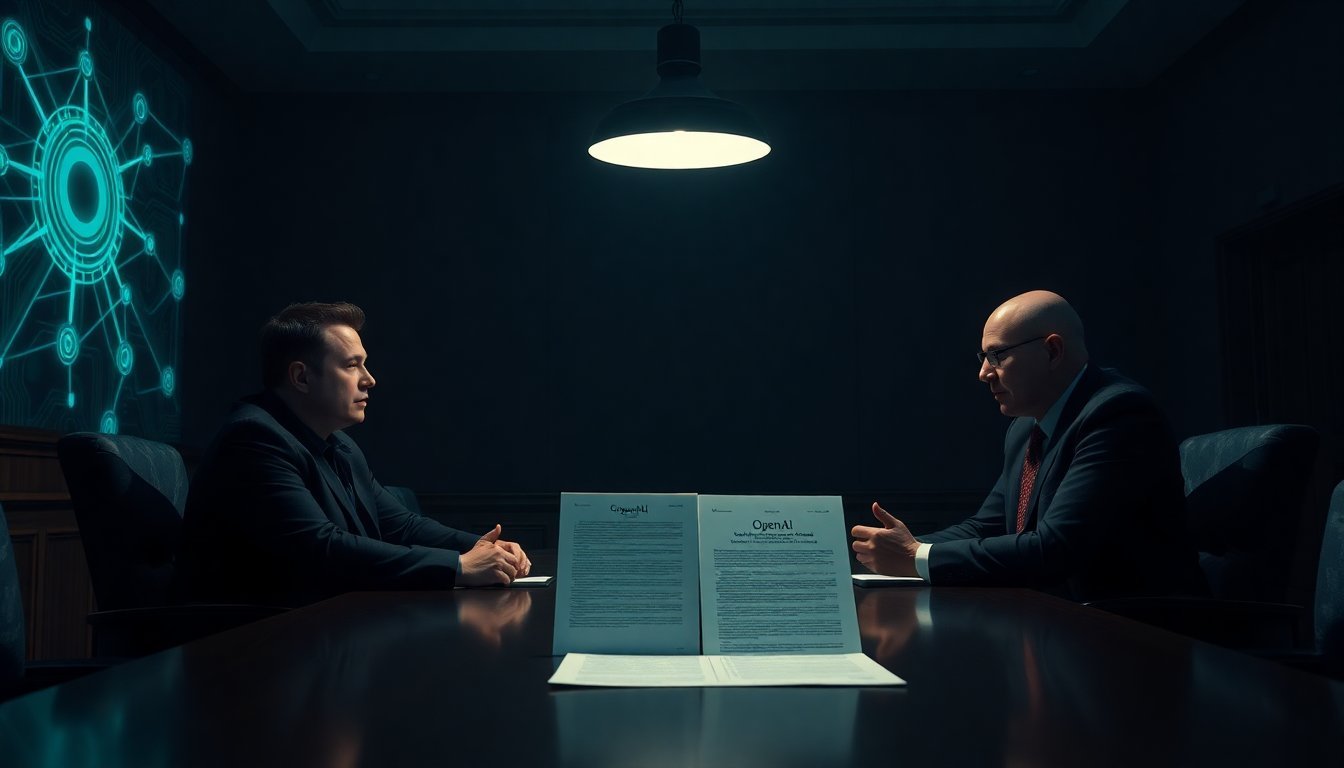
The Musk v. Altman trial is a referendum on AI’s founding myth. Musk claims OpenAI abandoned its nonprofit mission; Altman says he saved it. The outcome will determine who controls the narrative—and the technology.
Elon Musk and Sam Altman are in a San Francisco courtroom, and the question isn’t just who owns OpenAI—it’s whether the company’s founding promise of open, safe AI was ever real. The New York Times’s Cade Metz reported that the trial is examining OpenAI’s origins, but the real story is what happens when idealism meets billions of dollars.
What Did Musk and Altman Actually Agree to in 2015?
According to the New York Times’s Cade Metz, the trial is digging into the founding documents of OpenAI, which was established in December 2015 as a nonprofit with a stated mission to “advance digital intelligence in the way that is most likely to benefit humanity as a whole, unconstrained by a need to generate financial return.” Musk contributed $100 million in initial funding. The core dispute centers on whether the 2019 restructuring—which created a for-profit arm capped at 100x returns for investors—violated that original charter. Musk’s legal team has introduced emails and board minutes showing Altman allegedly assured early donors the nonprofit structure was permanent. Altman’s defense counters that the for-profit pivot was necessary to raise the billions required to compete with Google and maintain relevance.
Is This Really About Money or Control?
This is not a case about cash—it’s about narrative control. Musk walked away from OpenAI’s board in 2018, citing conflicts with his Tesla AI work, but he has never stopped trying to influence the company’s direction. The Verge reported that Musk’s lawsuit, filed in February 2024, seeks an injunction to block OpenAI from operating as a for-profit and demands the company return to its nonprofit roots. But the subtext is clear: Musk wants to be seen as the visionary who warned about profit-driven AI, while Altman wants to be seen as the pragmatist who made AI work in the real world. The trial’s outcome will determine which origin story becomes the official record—and that matters for future regulation and public trust.
What Does the Evidence Actually Show?
The evidence so far is messy. The Times reported that internal emails from 2015-2017 show Musk himself proposed creating a for-profit entity to attract top talent, contradicting his current stance. In one 2015 email, Musk wrote, “We need to raise a lot of money. That likely means a for-profit structure.” Altman’s team has seized on this as proof that Musk was always aware of the need for profit. However, Musk’s lawyers argue that the for-profit was meant to be a temporary vehicle, not the permanent structure OpenAI adopted in 2019. The jury will have to weigh conflicting testimony from early employees, including Ilya Sutskever, who has remained neutral but whose deposition could tip the scales.
Who Wins If Musk Prevails?
If Musk wins, the immediate impact would be a court order forcing OpenAI to unwind its for-profit structure—a move that would likely trigger a massive capital reallocation and potentially break Microsoft’s exclusive licensing deal. According to The Verge, Microsoft has invested over $13 billion in OpenAI and holds a 49% stake in the for-profit arm. A forced restructuring could void that deal, handing a win to competitors like Anthropic and Google DeepMind. But the bigger winner would be the open-source AI movement: a Musk victory would validate the argument that AI development must remain transparent and public-interest-driven, potentially chilling future profit-driven AI ventures.
What Happens If Altman Wins?
An Altman win would cement the for-profit model as the standard for AI development. It would signal that even the most idealistic AI projects must eventually bow to market realities. The immediate loser would be Musk, who would lose his leverage to shape OpenAI’s narrative. But the broader loser would be public trust: a Altman victory would reinforce the perception that AI companies will say anything to raise money and then pivot to profit once they have leverage. The EU AI Office is watching closely; according to a February 2025 statement, regulators are considering requiring all AI companies to disclose their founding mission and any changes to it. This trial could accelerate that regulatory push.
Comparison Table: Musk’s Vision vs. Altman’s Reality
| Dimension | Musk’s Claim | Altman’s Defense |
|---|---|---|
| Founding Mission | Nonprofit, open-source, for humanity | Always pragmatic; for-profit was discussed |
| 2019 Restructuring | Betrayal of original charter | Necessary to raise capital for AGI |
| Microsoft Relationship | Undue influence, loss of independence | Strategic partnership, not control |
| Musk’s Role | Co-founder, key funder, abandoned | Early donor who left voluntarily |
| Public Interest | Sacrificed for profit | Still central; profit enables safety research |
| Verdict | Musk: narrative coherence but weak on evidence of formal agreement | Altman: strong on practical necessity but weak on original promise |
My thesis: This trial is a collision of two incompatible narratives about AI’s purpose—one that views profit as corrupting, and one that views profit as enabling. In the short term, the market will react violently to any ruling that threatens Microsoft’s investment. If Musk wins, expect a 10-15% drop in Microsoft’s AI-related valuation and a surge in Anthropic’s stock. If Altman wins, expect OpenAI to accelerate its IPO plans, likely in 2027. The long-term consequence is more profound: this trial will define the legal boundaries of mission drift in technology companies. I predict that the EU AI Office will use the trial’s outcome to justify a new regulatory category—'Public Interest AI Entities'—that imposes transparency obligations on any company that changes its founding mission. The biggest losers are the early OpenAI employees who believed in the nonprofit vision; the biggest winners are the lawyers who will spend years untangling the mess.
Predictions
- Altman will win the trial but lose the narrative. The evidence of Musk’s own for-profit suggestions weakens his case, but the public will remember that Musk was right about the danger of profit-driven AI.
- Microsoft will restructure its OpenAI deal within 12 months of the verdict to reduce legal exposure, potentially capping its profit share at 25%.
- The EU AI Office will propose a 'Mission Integrity' regulation by Q1 2027 that requires all AI companies to publicly register their founding mission and get shareholder approval for any changes.
- December 2015OpenAI founded as nonprofit
OpenAI launched with $1 billion in pledges from Musk, Altman, and others, committed to open, safe AI.
- February 2018Musk leaves OpenAI board
Musk exits, citing conflicts with Tesla’s AI work.
- March 2019OpenAI creates for-profit arm
OpenAI restructures, creating a capped-profit entity to attract investment.
- July 2023Musk launches xAI
Musk founds xAI, directly competing with OpenAI.
- February 2024Musk files lawsuit
Musk sues OpenAI and Altman for breach of contract.
- April 2026Trial begins
Landmark trial starts in San Francisco federal court.
Timeline: Key Events in the Musk-Altman Rift
- December 2015: OpenAI founded as a nonprofit with $1 billion in pledges from Musk, Altman, and others.
- February 2018: Musk leaves OpenAI board, citing conflicts with Tesla’s AI work.
- March 2019: OpenAI creates a for-profit subsidiary, capped at 100x returns for investors.
- July 2023: Musk launches xAI, his own AI company, directly competing with OpenAI.
- February 2024: Musk files lawsuit against OpenAI and Altman, alleging breach of contract.
- April 2026: Trial begins in San Francisco federal court.
- The trial is not about the past—it’s about who gets to define AI’s future ethical and legal framework.
- Musk’s strongest argument is narrative; Altman’s strongest argument is the messy reality of early emails.
- The real winner may be regulators, who will use this case to justify new oversight.
- Open-source AI advocates should watch this case closely—a Musk win could legitimize their movement.
- Investors should prepare for volatility in Microsoft and OpenAI-related assets regardless of the verdict.

Source and attribution
NYTimes Technology
Musk vs. Altman: What Is This Really About?






Discussion
Add a comment