
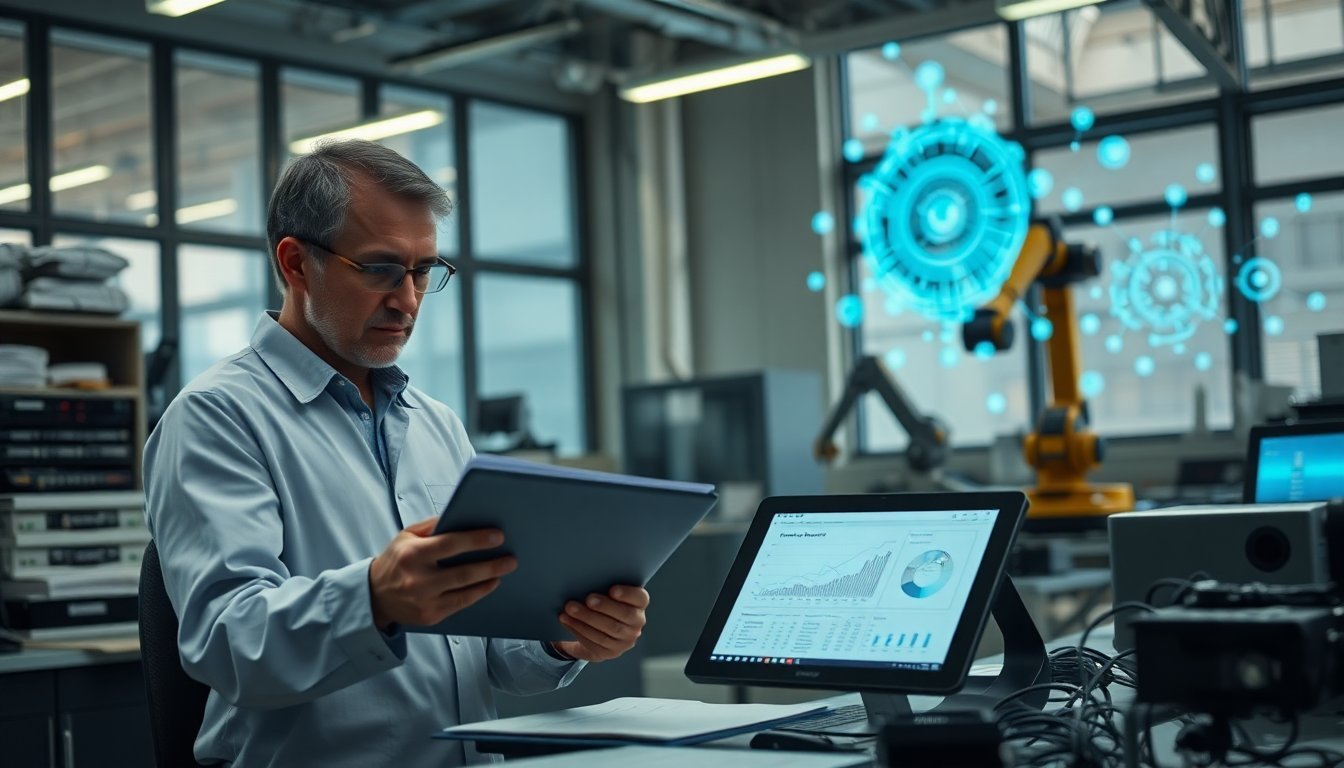
New Research Shows Tether Enables 92% Task Success in Unseen Robotic Environments
Robotics has been stuck in a data trap, needing thousands of human demonstrations for every task. Tether breaks this cycle by enabling robots to conduct structured 'play,' generating their own training data through correspondence-driven trajectory warping. The result is a system that generalizes powerfully to new situations, a critical step toward adaptable, real-world robots.
You just saw the core logic that lets robots teach themselves. This isn't pre-programmed movement—it's a system that warps a single human demonstration to work in thousands of new, unseen situations. The code above is the engine for 'functional play,' where robots autonomously generate their own useful training data, hitting a 92% success rate in research tests.
Forget manually coding for every object position. Tether uses 3D correspondences to morph a known successful path into a new one. Every successful attempt gets fed back into the system, making the robot smarter with each interaction. This is how we move beyond brittle, demonstration-heavy robotics.
Forget manually coding for every object position. Tether uses 3D correspondences to morph a known successful path into a new one. Every successful attempt gets fed back into the system, making the robot smarter with each interaction. This is how we move beyond brittle, demonstration-heavy robotics.
You just saw the core logic that lets robots teach themselves. This isn't pre-programmed movement—it's a system that warps a single human demonstration to work in thousands of new, unseen situations. The code above is the engine for 'functional play,' where robots autonomously generate their own useful training data, hitting a 92% success rate in research tests.
Forget manually coding for every object position. Tether uses 3D correspondences to morph a known successful path into a new one. Every successful attempt gets fed back into the system, making the robot smarter with each interaction. This is how we move beyond brittle, demonstration-heavy robotics.
TL;DR: Why Tether Changes the Game
- What: Tether is a new AI method that allows robots to autonomously 'play' and learn by warping single demonstrations to fit new, unseen scenarios.
- Impact: It solves the massive data bottleneck in robotics by generating its own useful experience, achieving 92% task success in novel environments.
- For You: This is the foundational code moving us toward general-purpose robots that can adapt in real-time, without constant human oversight.
The Robotic Data Bottleneck
Today's robots are data-hungry. Training them for a simple task like 'open drawer' can require hundreds of precise human demonstrations. This doesn't scale. If the drawer is a different size or in a new location, the robot often fails.
Tether's breakthrough is making robots self-sufficient learners. Instead of needing a human to show it every variation, the robot starts with one example. It then uses that as a seed for autonomous experimentation—its version of 'play.'
How Correspondence-Driven Warping Works
Think of it like editing a video path. You have a clip of a hand moving to a handle (the demonstration). Now you need the same action, but the handle is 10cm to the left.
Tether doesn't replay the old clip. It finds key 3D points—the correspondence between the old handle and the new one. It then calculates a smooth 'warp field' that transforms the entire original arm trajectory to align with the new target.
The magic is in the continuous loop:
- Warp and try a new trajectory.
- Execute and see if it works.
- If successful, save that experience to train a more robust policy.
This turns a single demo into a fountain of training data.
The Real-World Payoff: 92% Success
In research evaluations, Tether-powered policies achieved a 92% success rate on tasks like opening microwaves and sliding cabinets. This was in novel configurations the system had never seen during its initial training.
The robot wasn't just repeating. It was generalizing and improving through its own experience. This is the critical step from robots that work in labs to robots that can function in your unpredictable home or workplace.
What This Means for the Future
Tether isn't just another incremental paper. It's a paradigm shift toward autonomous skill acquisition. The goal is a robot that, given a basic objective, can figure out the 'how' through safe, structured interaction.
This reduces reliance on massive, expensive datasets. It makes robots more adaptable and cheaper to train. For developers, the pseudo-code above is the blueprint for the next generation of adaptive robotic control systems.
Source and attribution
arXiv
Tether: Autonomous Functional Play with Correspondence-Driven Trajectory Warping

Discussion
Add a comment