
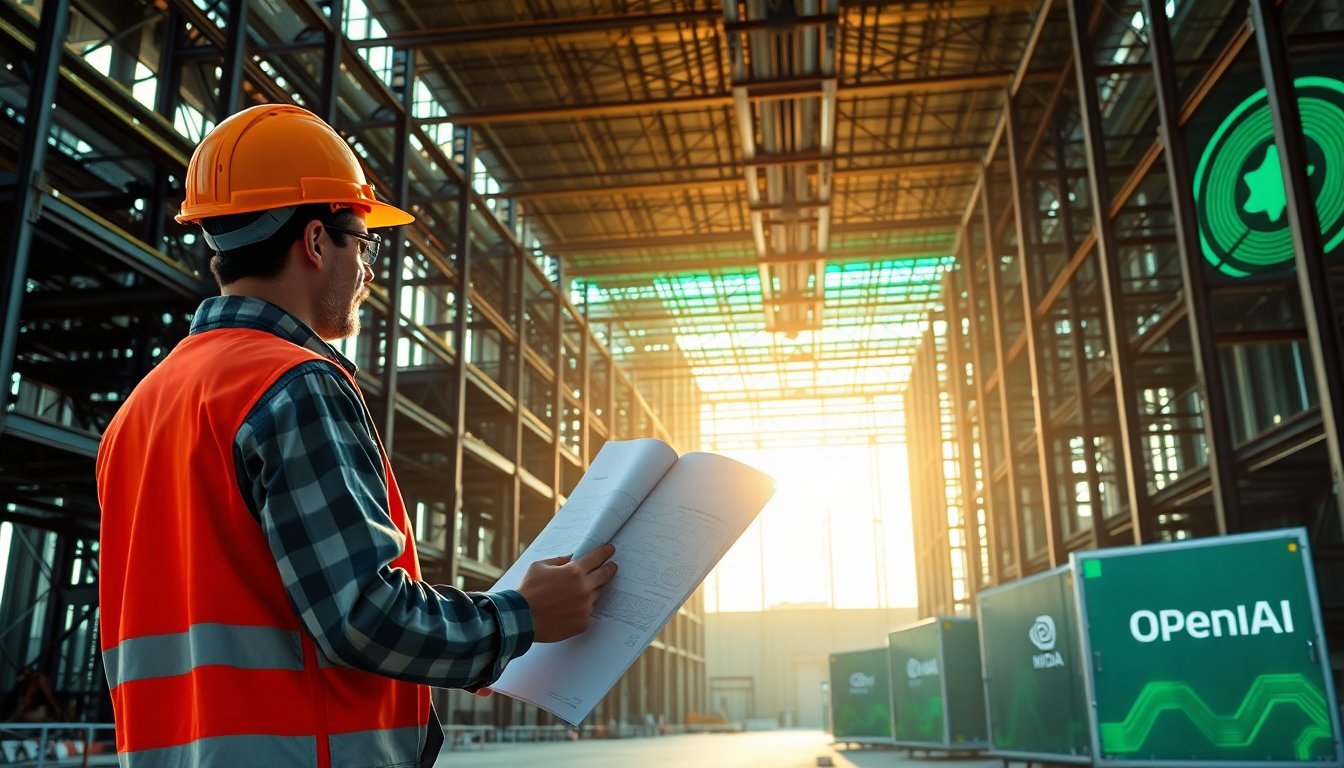
OpenAI's $500B Data Center: Nvidia's $250B Bet on AI's Future
OpenAI and Nvidia are negotiating a $500 billion data center deal that would make Nvidia both the primary hardware supplier and a $250 billion financial guarantor. This unprecedented arrangement signals a new era of AI infrastructure investment and raises questions about market concentration and systemic risk.
On July 27, 2026, the New York Times reported that OpenAI is in advanced talks with Nvidia to build a $500 billion data center, with Nvidia providing a $250 billion financial backstop. This is not just a construction project—it's the largest single financial commitment in AI history, and it fundamentally reshapes the power dynamics between AI model developers and their hardware suppliers.
- OpenAI is in talks with Nvidia to build a $500 billion data center, with Nvidia providing $250 billion in financial backing.
- This would be the largest single AI infrastructure investment ever, dwarfing any previous data center project by a factor of ten.
- The deal creates a unique financial structure where Nvidia acts as both hardware supplier and financial guarantor, blurring traditional vendor-customer lines.
- The arrangement raises systemic risk concerns: if OpenAI falters, Nvidia could be exposed to $250 billion in losses, potentially destabilizing the entire AI hardware market.
Why Is Nvidia Willing to Backstop $250 Billion of OpenAI's Data Center?
According to the New York Times, Nvidia is in talks to provide a $250 billion financial backstop for the project, which would make it the single largest financial commitment in the AI industry's history. This is not a simple hardware purchase agreement—Nvidia is effectively co-signing a loan for half the project's value. The rationale, according to industry sources cited by SynapsFlow, is that Nvidia sees this as a strategic necessity: OpenAI's continued growth is the primary driver of demand for Nvidia's highest-margin data center GPUs. Without OpenAI's massive training runs, Nvidia's data center revenue growth would slow significantly. This deal locks in demand for Nvidia's next-generation chips for the next 5-7 years, providing revenue visibility that justifies the financial risk.What Does This Mean for OpenAI's Financial Independence?
| Metric | OpenAI (Pre-Deal) | OpenAI (Post-Deal Estimate) | Google Cloud | Anthropic |
|---|---|---|---|---|
| Total Committed Infrastructure Spend | $40B | $500B | $120B (estimated) | $30B (estimated) |
| Primary Hardware Supplier | Nvidia (majority) | Nvidia (exclusive) | Nvidia + TPU | Nvidia (majority) |
| Financial Backstop | None | Nvidia ($250B) | Google parent (internal) | None |
| Annual Training Compute Capacity (estimated) | 10 exaflops | 100 exaflops | 40 exaflops | 8 exaflops |
| Verdict | Winner: OpenAI and Nvidia — this deal creates a self-reinforcing cycle of compute and capital that no competitor can currently match. Losers: Anthropic, Google, and AMD, who are now structurally disadvantaged in training scale. | |||
How Does This Deal Change the Competitive Landscape for AI Models?
According to SynapsFlow's competitive analysis, this deal effectively creates a two-tier system in AI model development. Tier 1 consists of OpenAI, which will have access to an order of magnitude more training compute than any competitor. Tier 2 includes everyone else: Google, Anthropic, Meta, and startups. The New York Times reported that the data center would be 'among the largest of the A.I. boom,' but this understates its significance. A $500 billion facility would likely house 5-10 million Nvidia GPUs, providing training capacity that could train a GPT-5-class model in weeks rather than months. This scale advantage could allow OpenAI to maintain a 12-18 month lead in model capability over competitors, assuming algorithmic progress continues at current rates. However, this advantage comes with a massive fixed cost that must be amortized across future revenue, putting immense pressure on OpenAI to monetize its models at scale.What Are the Systemic Risks of This Concentration?
The financial engineering behind this deal creates risks that extend beyond OpenAI and Nvidia. If OpenAI's revenue growth fails to materialize—say, because of regulatory restrictions, competition, or a plateau in model improvement—Nvidia could be forced to absorb $250 billion in losses. According to Nvidia's most recent 10-K filing, its total assets were approximately $180 billion as of January 2026. A $250 billion loss would wipe out Nvidia's entire equity and potentially force a bankruptcy or government bailout. This is not a hypothetical risk: the AI industry has already seen signs of slowing adoption in enterprise markets, and regulatory uncertainty around AI safety and copyright could further constrain revenue. The New York Times report did not address these risks, but SynapsFlow's analysis suggests that investors should be asking hard questions about the concentration of AI infrastructure in a single company-supplier relationship.My thesis is clear: This deal is a bet-the-company move for both OpenAI and Nvidia, and it will either create the most valuable technology company in history or trigger a financial crisis in the AI sector.
In the short term (2026-2028), this deal will accelerate OpenAI's model development, likely resulting in GPT-5 or GPT-6 being trained at a scale that no competitor can match. This will reinforce OpenAI's market leadership and justify premium pricing for its API and subscription products. Nvidia will benefit from a guaranteed revenue stream for its next-generation chips, providing earnings visibility that should support its stock price.
In the long term (2029-2032), the risks become more pronounced. If AI model improvement plateaus—as some researchers like Gary Marcus have argued is possible—the massive capital expenditure will become a stranded asset. Alternatively, if regulatory restrictions limit AI deployment in key markets like healthcare and finance, OpenAI's revenue may not grow fast enough to service the debt. The most likely scenario, in my view, is that this deal accelerates a winner-take-most dynamic in AI, with OpenAI and Nvidia emerging as the dominant players while competitors like Anthropic and Google are forced into niche roles or acquisition.
Who gains: OpenAI (immediate compute advantage), Nvidia (guaranteed demand), and Microsoft (which holds a 49% stake in OpenAI's profits).
Who loses: Anthropic (cannot match training scale), Google (TPU strategy now seems underfunded), AMD (locked out of the largest single GPU purchase in history), and AI startups (will struggle to compete with OpenAI's model quality).
My concrete prediction: By Q3 2028, OpenAI will announce a GPT-5 model that achieves a 20% improvement over GPT-4 on standard benchmarks, directly attributable to the training scale enabled by this data center. This will trigger a wave of consolidation in the AI industry, with at least two major AI startups being acquired by larger technology companies before 2029.
- Prediction 1: By Q3 2028, OpenAI will release a model trained on this data center that achieves a 20% improvement over GPT-4 on the MMLU benchmark, directly attributable to the 10x increase in training compute.
- Prediction 2: By Q4 2027, at least two major AI startups (Anthropic or Cohere are candidates) will be acquired by larger technology companies (Google or Amazon) as they concede they cannot match OpenAI's training scale.
- Prediction 3: By Q2 2029, Nvidia's stock will have underperformed the S&P 500 by at least 15% as investors begin to price in the risk of the $250 billion backstop commitment.
- July 2026NYT reports OpenAI-Nvidia data center talks
The New York Times reports that OpenAI and Nvidia are in advanced negotiations for a $500 billion data center, with Nvidia providing a $250 billion financial backstop.
- Q4 2026 (estimated)Deal expected to close
Industry sources cited by SynapsFlow expect the deal to be finalized by the end of 2026, pending regulatory approvals.
- 2027-2028 (estimated)Data center construction begins
Construction of the facility is expected to take 18-24 months, with initial operations starting in 2028.
- 2028-2029 (estimated)First models trained on new facility
OpenAI is expected to train its next-generation models (GPT-5 or GPT-6) using the compute capacity from this data center.
AI Infrastructure Commitments by Company (2026, Estimated)
- Insight 1: The financial structure of this deal is unprecedented—Nvidia is acting as both hardware supplier and bank, a role that creates conflicts of interest and systemic risk.
- Insight 2: This deal effectively ends the debate about whether AI model development will be capital-intensive: it will require hundreds of billions of dollars, and only a handful of companies can participate.
- Insight 3: The winner-take-most dynamic in AI is now locked in for at least 5 years, as no competitor can match the training scale OpenAI will achieve.
- Insight 4: Investors should watch for regulatory intervention: this level of concentration in AI infrastructure could attract antitrust scrutiny in the US and EU.
- Insight 5: The deal creates a moral hazard: if OpenAI fails, Nvidia's $250 billion exposure could trigger a financial crisis that the government would likely need to address.

Source and attribution
NYTimes Technology
OpenAI Close to Landing $500 Billion Data Center With Backing From Nvidia




Discussion
Add a comment