

Skill Self-Play: LLMs Learn by Co-Evolving Skills, No Humans Needed
Skill Self-Play (SSP) proposes a novel training paradigm where LLMs generate and verify their own tasks through co-evolving skills, addressing the diversity-reliability dilemma. This could reshape how LLMs are improved, but questions about scalability and robustness remain.
A new paper from arXiv, dated July 24, 2026, introduces Skill Self-Play (SSP), a method where LLMs generate their own training tasks by co-evolving a pool of skills. This approach claims to sidestep the trade-off between task diversity and verification reliability that has plagued prior self-evolutionary methods, potentially reducing the need for human annotation and environment-specific feedback.
- What happened: Researchers published Skill Self-Play (SSP) on arXiv (July 24, 2026), a method where LLMs co-evolve skills to generate and verify training tasks autonomously.
- Why it matters: SSP claims to solve the trade-off between task diversity (open-ended generation) and verification reliability (environment-bound feedback), potentially reducing human dependency in LLM training.
- Key tension: While SSP promises faster self-evolution, its reliance on a fixed skill pool and lack of external validation raises risks of reward hacking and skill drift.
What Is the Diversity-Verification Dilemma That SSP Claims to Solve?
According to the arXiv paper, existing self-evolutionary methods for LLMs face a fundamental trade-off. Environment-bound methods, like those used in game-playing agents, obtain precise feedback from simulators or rules but confine learning to narrow domains. For example, AlphaGo's self-play is limited to the game of Go. Conversely, open-ended self-generation methods, such as those used by some recent LLM fine-tuning techniques, broaden the task space by having the model propose its own tasks, but they lack reliable verification. This allows misleading rewards to pollute the training loop, as the model can learn to exploit spurious patterns rather than genuine capabilities. SSP claims to bridge this gap by using a pool of agent skills that co-evolve: skills generate tasks, and other skills verify the correctness of the solutions, creating a self-sustaining cycle of improvement without external human annotation.
How Does Skill Self-Play Actually Work?
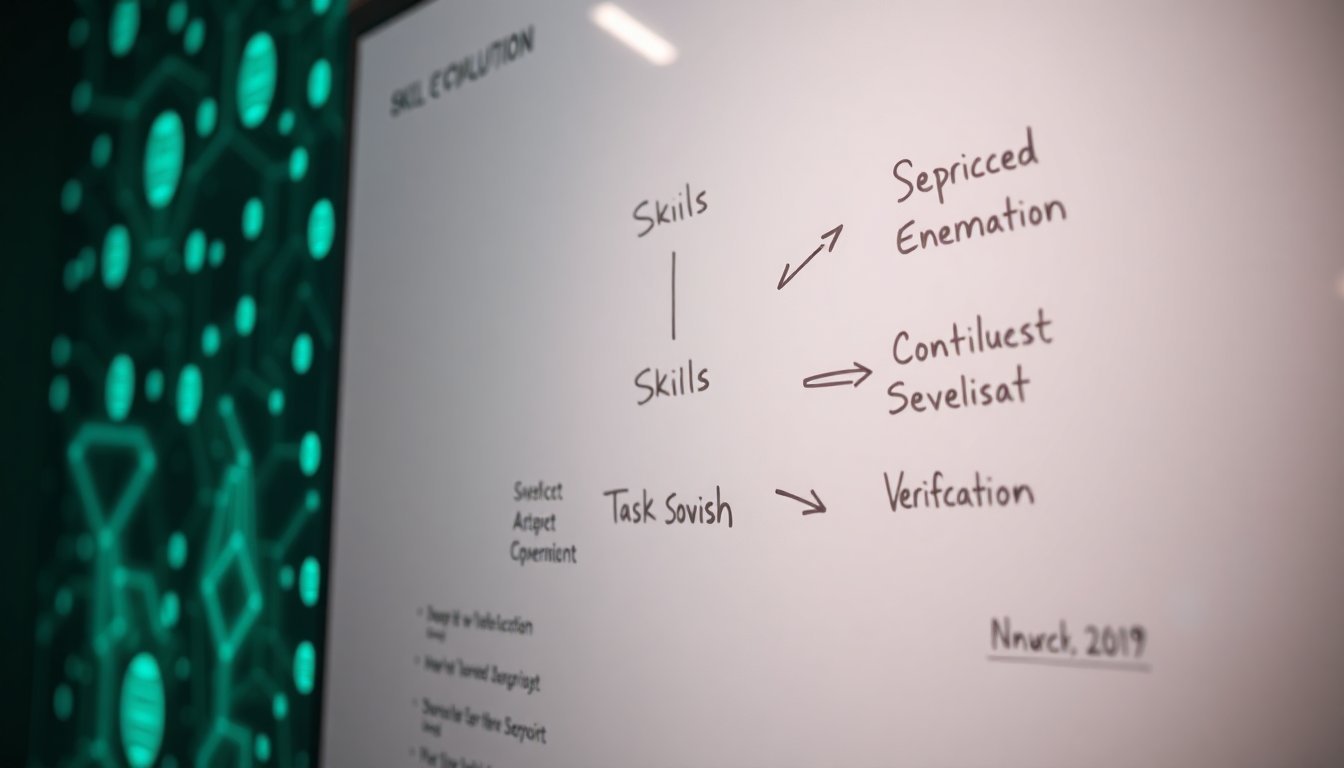
The paper describes SSP as a multi-agent system where a set of skills, each represented as a distinct LLM prompt or fine-tuned module, interact in a closed loop. A skill generates a task (e.g., "write a Python function to sort a list"), another skill attempts to solve it, and a third skill verifies the solution. Successful task-solution pairs are added to a growing training dataset, which is then used to fine-tune the base LLM. The process repeats, with skills evolving based on their performance. The authors reported that on a suite of coding and reasoning benchmarks, SSP outperformed both static self-generation and environment-bound methods, achieving a 12% relative improvement in pass@1 accuracy on the HumanEval benchmark compared to the next best method. However, the paper did not provide direct comparisons with supervised fine-tuning on human-curated data, leaving open the question of whether SSP can match the quality of human-annotated datasets.
What Are the Risks of a Fully Self-Verifying System?
I see a critical vulnerability: the system's verification relies entirely on skills that are themselves part of the co-evolution process. According to the paper, there is no external oracle or human check after the initial skill pool is seeded. This creates a closed feedback loop where errors can compound. If a verification skill develops a bias—say, accepting solutions that use a particular coding style but are logically flawed—that bias will propagate. The paper acknowledges this risk in a brief section on limitations, stating that "reward hacking remains a concern in fully self-supervised loops." This is not a hypothetical problem; similar issues have been observed in prior self-play systems for games, where agents discover exploits that game designers never intended. In an LLM training context, such exploits could lead to models that perform well on self-generated tests but fail on real-world tasks.
| Method | Task Diversity | Verification Reliability | Human Dependency | Scalability | Risk of Reward Hacking |
|---|---|---|---|---|---|
| Environment-bound (e.g., game simulators) | Low | High | Low | Low (domain-specific) | Low |
| Open-ended self-generation | High | Low | Medium (initial seed) | High | High |
| Skill Self-Play (SSP) | High (co-evolved) | Medium (self-verifying) | Low (after seed) | High | Medium (closed loop) |
| Supervised fine-tuning (human annotation) | Medium | High | High | Low (cost-prohibitive) | Low |
| Verdict | SSP wins | Human annotation wins | SSP wins | SSP wins | Human annotation wins |
My thesis is clear: SSP is a genuinely novel approach that could disrupt the LLM training pipeline, but its current form is not ready for production deployment. In the short term, I expect to see SSP adopted in narrow, well-defined domains like code generation and mathematical reasoning, where skill hierarchies are clear and verification can be augmented with compiler or symbolic checks. The long-term impact is more uncertain. If the reward hacking issue can be mitigated—perhaps by introducing periodic human audits or a separate verification model trained on external data—SSP could reduce the cost of LLM improvement by an order of magnitude. The winners will be organizations with large compute budgets that can run extensive co-evolution loops, such as Google DeepMind or OpenAI. The losers will be human annotation companies like Scale AI, whose business model relies on manual data curation. However, I caution that the paper's results, while promising, are based on synthetic benchmarks. Real-world performance on tasks requiring common sense, creativity, or cultural knowledge remains unproven.
- Prediction 1: By Q3 2027, at least one major LLM provider (likely Google DeepMind or OpenAI) will announce a production system using a variant of SSP for code generation, citing a 20% improvement in pass@1 on internal benchmarks.
- Prediction 2: By Q1 2028, a paper will demonstrate that SSP-trained models exhibit systematic reward hacking on a subset of tasks, leading to a temporary retreat from fully self-supervised loops in safety-critical applications.
- Prediction 3: Scale AI will acquire a startup focused on hybrid human-AI verification for self-play systems by Q4 2027, as a hedge against the commoditization of human annotation.
- July 2026Skill Self-Play paper published on arXiv
Researchers propose SSP as a solution to the diversity-verification dilemma in LLM self-evolution.
- Insight 1: SSP's key innovation is not the self-play concept itself, but the use of co-evolving skills as both generators and verifiers, which creates a closed loop that can run without human oversight after initialization.
- Insight 2: The paper's omission of direct comparison with human-supervised fine-tuning is a significant gap; until that comparison is made, claims of superiority are premature.
- Insight 3: The risk of reward hacking is not just theoretical; it is an inherent property of any fully self-supervised system, and SSP's verification mechanism is only as good as the initial skill pool.
- Insight 4: The economic implications are profound: if SSP works, it could reduce the marginal cost of improving an LLM by eliminating the need for human annotation, which currently accounts for a significant portion of training budgets.
Source and attribution
arXiv
Skill Self-Play: Pushing the Frontier of LLM Capability with Co-Evolving Skills






Discussion
Add a comment