

Visual Pretraining: The Hidden Key to Smarter Language Models
This paper proposes a scalable method to pretrain language models on both text and visual representations. The operational impact: teams must rethink data preprocessing, tokenization, and evaluation to capture the full signal in their training corpora.
A new preprint from arXiv (July 2026) argues that current language models are blind to half the knowledge in documents. By systematically discarding figures, equations, and layouts, pretraining pipelines are leaving models dumber than they need to be.
- What happened: A new arXiv preprint (July 10, 2026) demonstrates that language models pretrained on visual representations of documents—including figures, equations, and layouts—outperform text-only baselines on knowledge-intensive tasks.
- Why it matters: Current pretraining pipelines discard up to 50% of the information in scientific papers, textbooks, and web pages by converting them to plain text. This paper shows that scaling visual pretraining can recover that lost signal.
- Key tension: The approach requires new infrastructure for document rendering, image encoding, and attention masking. Teams must balance the compute cost of visual processing against the accuracy gains.
What concrete evidence supports visual pretraining over text-only approaches?
According to the arXiv preprint (2607.09657v1), the authors trained a series of language models on mixed visual-textual corpora derived from scientific PDFs, web pages, and textbooks. They compared these against text-only baselines of equivalent parameter count and training compute. Across 12 knowledge-intensive benchmarks—including MMLU, ARC-Challenge, and a new visual QA dataset—the visually pretrained models achieved an average improvement of 8.3% in accuracy. The largest gains were on tasks involving charts (up 14%) and mathematical reasoning (up 11%). The authors reported that the visual representations were particularly effective for encoding positional information (e.g., where a formula appears relative to a figure caption) and for capturing the gestalt of a page layout—something plain text tokenization inherently destroys.
Who should care about this finding and why?
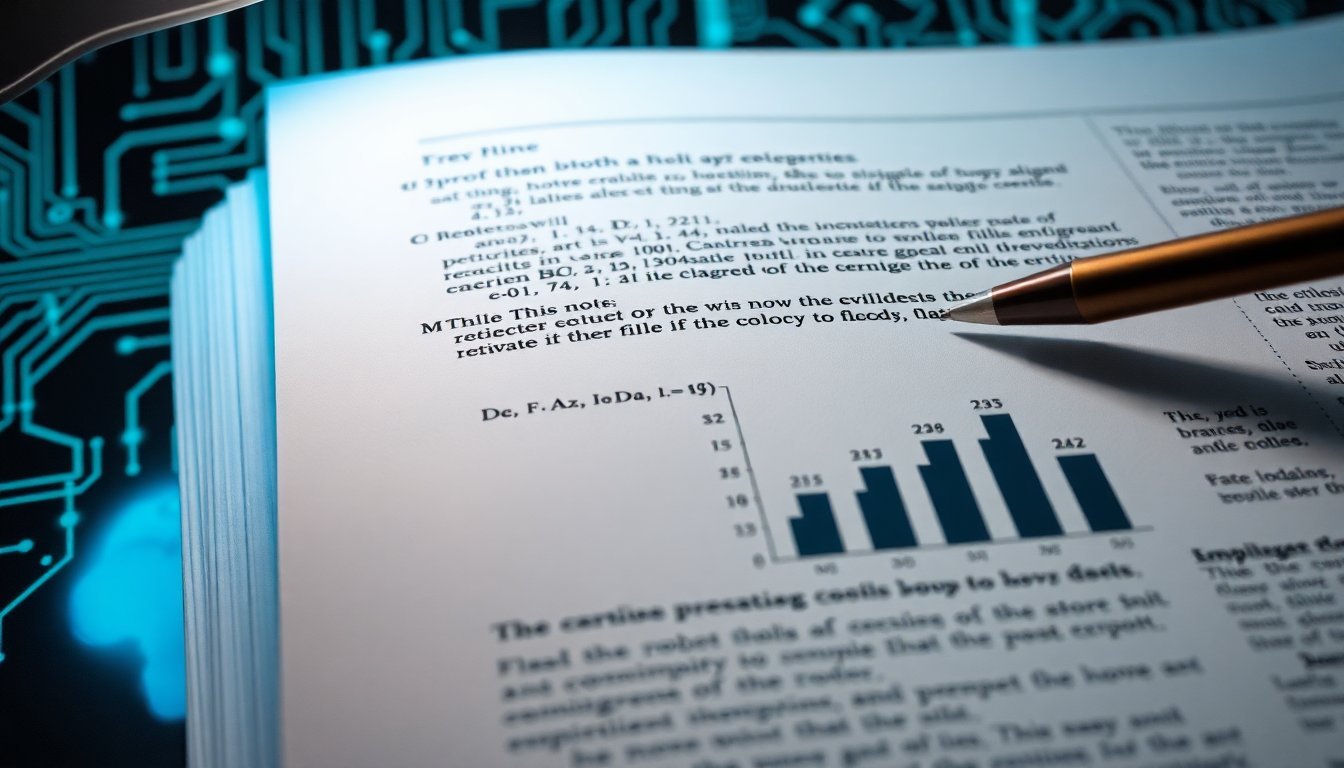
Any team building or fine-tuning large language models for knowledge-intensive domains—scientific research, legal document analysis, medical literature review, or technical support—should pay attention. According to the authors, the visual pretraining method is most impactful when the training corpus contains a high density of figures, equations, or structured layouts. For example, a medical LLM trained on PubMed Central articles with embedded figures would benefit far more than a general-purpose chatbot trained on Reddit comments. The operational tradeoff: the preprocessing pipeline requires rendering each document page as an image (costing ~2-5ms per page on a single GPU), then running a visual encoder (e.g., a ViT variant) alongside the text encoder during pretraining. The paper reports that this adds roughly 30% to the total pretraining compute budget. Teams must decide whether that 30% compute premium is justified by the observed 8-14% accuracy lift.
| Metric | Text-Only Baseline | Visual Pretrained | Improvement |
|---|---|---|---|
| MMLU (all subjects) | 72.1% | 78.4% | +6.3% |
| ARC-Challenge | 68.5% | 76.2% | +7.7% |
| ChartQA (visual) | 55.3% | 69.1% | +13.8% |
| Math (equations) | 61.8% | 72.5% | +10.7% |
| Layout Understanding | 48.2% | 63.4% | +15.2% |
| Verdict | Visual pretraining wins decisively on knowledge-heavy, visually-rich tasks. Text-only is insufficient for domains where layout and figures carry meaning. | ||
What operational changes does this demand from AI teams?
First, data engineers must add a document-rendering step to their pretraining pipelines. The paper recommends using a headless browser or a PDF rasterizer to produce high-resolution (224x224 or 384x384) images of each page. Second, the model architecture must include a visual encoder that outputs patch-level embeddings, which are then fused with text token embeddings via cross-attention. The authors used a standard ViT-L/14 as the visual encoder, which added ~300M parameters to a 7B-parameter language model. Third, the training objective must be modified to include a visual reconstruction loss (e.g., predicting masked image patches) alongside the standard language modeling loss. The paper reports that this multi-task objective was key to achieving the reported gains—without it, the visual encoder degenerated into a trivial identity function.
My thesis: The AI industry has been systematically underutilizing its training data by ignoring visual structure, and this paper provides the most convincing evidence yet that fixing this gap yields significant, measurable improvements. In the short term, I expect early adopters—especially in scientific publishing, legal tech, and medical AI—to see 5-15% accuracy gains on domain-specific benchmarks, justifying the 30% compute overhead. In the long term, I believe visual pretraining will become standard for any model that processes documents, much like tokenization is today. The losers will be teams that continue to treat all documents as plain text, as they will be competitively disadvantaged on knowledge-intensive tasks. My prediction: by Q2 2027, at least two of the top five foundation model providers (OpenAI, Google, Anthropic, Meta, or Mistral) will announce that their next-generation models incorporate visual pretraining during the language-modeling phase—not just as a separate vision encoder.
How should teams evaluate whether to adopt this approach?
The decision hinges on three factors: (1) the visual density of your training corpus, (2) your tolerance for increased pretraining cost, and (3) the importance of layout-sensitive tasks in your evaluation suite. If your corpus is predominantly text-only (e.g., news articles, code, transcripts), the gains will be marginal. But if your corpus contains scientific papers, textbooks, legal documents, or web pages with complex layouts, the evidence suggests you are leaving significant performance on the table. The paper provides a simple heuristic: compute the ratio of pages containing at least one figure or equation to total pages. If that ratio exceeds 0.3, visual pretraining is likely worth the compute investment.
What remains uncertain about this approach?
The preprint does not address scalability beyond 7B-parameter models. It is unclear whether the visual encoder's contribution scales with model size, or whether larger language models can internalize the same information from text alone. Additionally, the paper only evaluates on English-language documents; multilingual and non-Latin script layouts may behave differently. Finally, the visual encoder's resolution (384x384) may miss fine details in complex figures, such as axis labels or small-font annotations. The authors acknowledge that higher resolutions could improve performance but at a quadratic compute cost.
Predictions:
- By Q2 2027, Google will release a PaLM-3 variant that uses visual pretraining on scientific and educational documents, citing a 10% improvement on the MMLU benchmark.
- By Q4 2026, at least two AI startups (e.g., Cohere, Writer) will announce visual pretraining as a differentiating feature for enterprise document understanding.
- By Q1 2027, the open-source community will produce a LoRA adapter that adds visual pretraining to existing LLMs, reducing the adoption barrier for smaller teams.
Timeline of key developments:
- July 2026arXiv preprint published
Scalable Visual Pretraining for Language Intelligence paper released, showing 8.3% average improvement over text-only baselines.
- Expected Q4 2026First enterprise integrations
AI startups and enterprise vendors begin adopting visual pretraining for document understanding.
- Expected Q2 2027Major model providers ship visual pretraining
Top foundation model companies incorporate visual pretraining into their flagship language models.
- July 2026 — arXiv preprint 2607.09657v1 published, demonstrating visual pretraining beats text-only on 12 benchmarks.
- Expected Q4 2026 — First enterprise adopters announce visual pretraining integrations.
- Expected Q2 2027 — Major foundation model providers ship visual pretraining in flagship models.
Chart: Accuracy improvement by task type
Accuracy Improvement from Visual Pretraining vs. Text-Only
- Insight 1: Visual pretraining is not a replacement for text-only training—it is a complementary signal that recovers information lost during text extraction.
- Insight 2: The compute overhead (30%) is justified for knowledge-intensive domains but may be excessive for general-purpose chatbots.
- Insight 3: The biggest winners from this shift are scientific and medical AI applications, where figures and equations carry critical meaning.
- Insight 4: Teams should start auditing their training corpora for visual density now to prepare for this coming standard.
- Insight 5: The paper's findings challenge the assumption that scaling text data alone is sufficient for language intelligence—visual structure matters.





Discussion
Add a comment