
🔥 Quantum Computing Meme Format
Instantly create relatable tech humor that explains complex concepts simply.
This isn't just an upgrade; it's a computing mullet. We now have a machine with the steady reliability we need for business in the front, and a wild, unprecedented quantum party in the back. So, what does this bizarre and brilliant fusion actually mean for you?
So, scientists just invented the computing equivalent of a mullet. Business in the front, quantum party in the back.
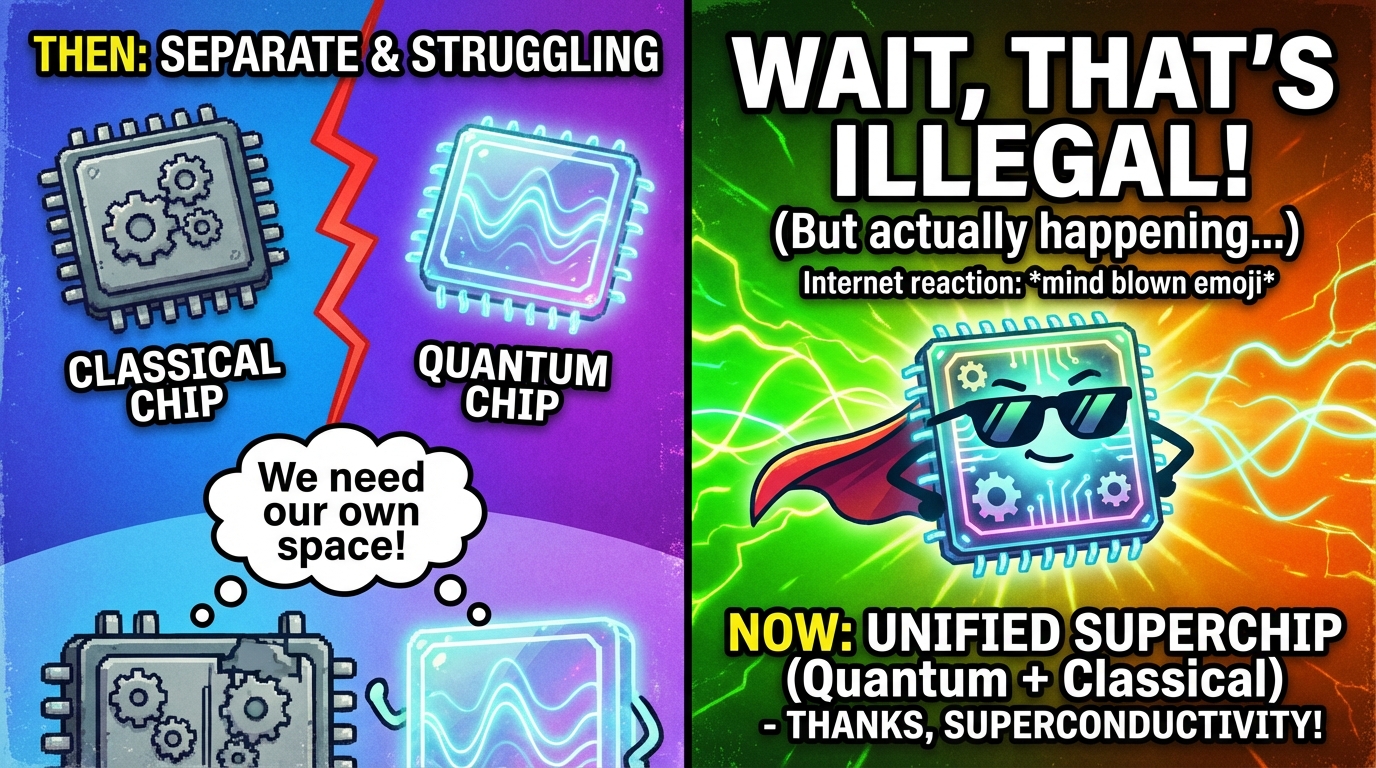
The news is that researchers have created a new semiconductor that could let classical and quantum computing happen on the same chip. Basically, they’re trying to get the sensible, spreadsheet-loving part of a computer to room-share with its weird, spooky, probability-defying sibling. It’s like building a duplex where one tenant pays rent on time and the other one occasionally exists in two places at once and owes you rent in multiple parallel universes.
This is all thanks to a superconductivity breakthrough. For those of us who failed high school physics, superconductivity is when a material lets electricity zip through it with zero resistance. It’s basically the material saying, “Go on, flow, be free! I won’t judge!” Getting this to work on a chip that also does normal computing is a huge deal. It’s the tech version of convincing your cat to peacefully coexist with your new puppy. Possible, but it’s going to be a delicate, potentially chaotic situation.
Imagine the help desk tickets. “My computer solved my tax return and also calculated the probability of my cat being in a superposition of ‘on the couch’ and ‘in the fridge’ at the same time. Which answer do I submit to the IRS?” Or your laptop finally rendering a complex video, while simultaneously using quantum magic to find the absolute optimal way to organize your Spotify playlists. The future is one where your computer can both crash Excel and not crash Excel in a different timeline.
In all seriousness, this is a massive step. It could make quantum computing more practical and less of a mysterious, room-sized science experiment. We’re talking about blending the reliable computer we know with the mind-bending computer of tomorrow.
So get ready. The era of the hybrid chip is coming. Your next device might just be part accountant, part psychic. Just don’t ask it to explain its answers, or you might get a headache that exists in two dimensions.
Quick Summary
- What: Scientists created a hybrid computer combining classical and quantum computing elements.
- Impact: This breakthrough could solve complex problems much faster than current computers.
- For You: You'll learn how future computers might eliminate frustrating processing delays.


💬 Discussion
Add a Comment